
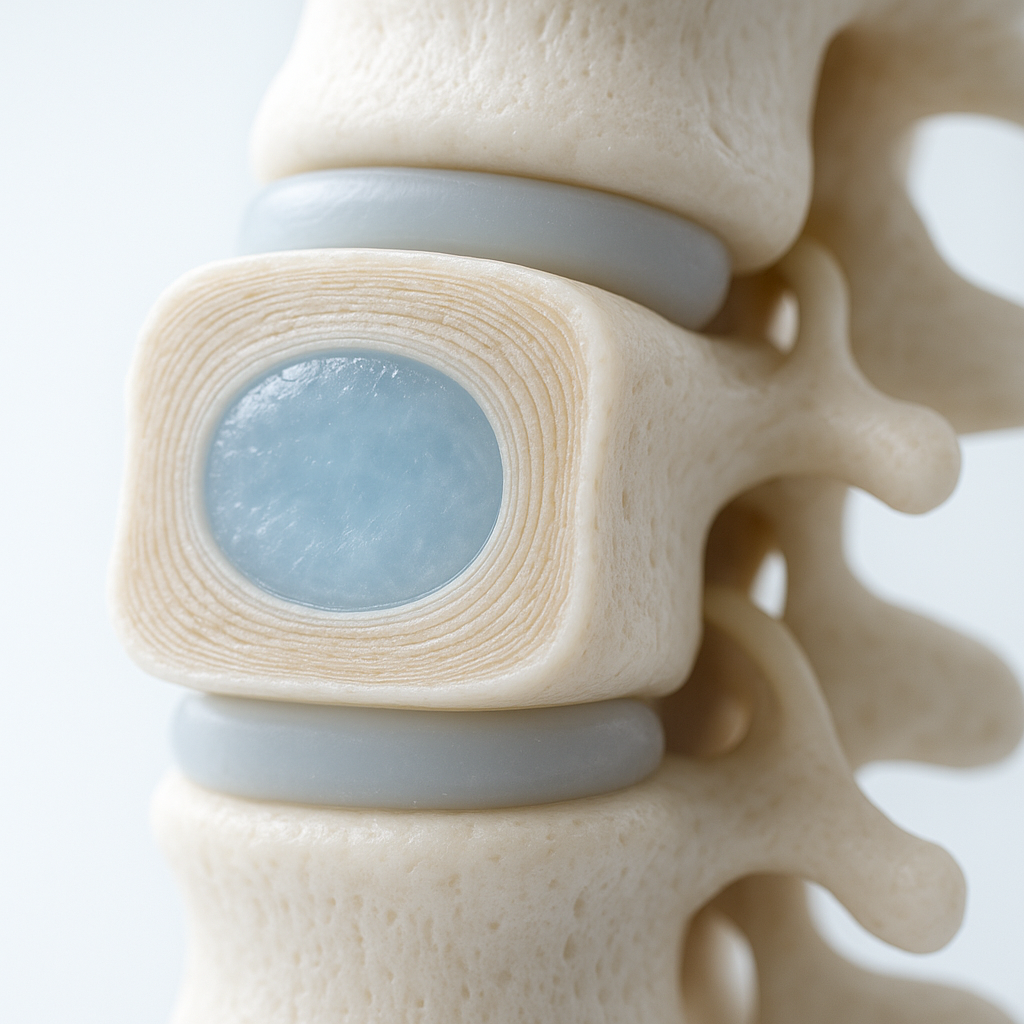
Understanding the Spinal Disc: A Foundation of Spinal Health
The human spine is one of the most remarkable structural achievements in the natural world. It provides support, flexibility, and protection for the central nervous system — all at the same time. At the heart of this complex system lies a deceptively simple structure: the intervertebral disc. Though small in size, these discs play an outsized role in how we move, stand, and live our daily lives. Understanding what a spinal disc is, how it functions, and why it matters can help you make more informed decisions about your spinal health.
What Exactly Is a Spinal Disc?
A spinal disc, formally known as an intervertebral disc, is a fibrocartilaginous structure situated between each pair of adjacent vertebrae in the spine. The human spine contains 33 vertebrae in total, and between most of these bones, you will find an intervertebral disc acting as a connector, shock absorber, and spacer.
In total, there are 23 intervertebral discs in the human spine. They are located between vertebrae in the cervical (neck), thoracic (mid-back), and lumbar (lower back) regions. The sacral and coccygeal vertebrae are fused and do not require discs between them.
Each disc is firmly anchored to the vertebral bodies above and below it, forming a joint that allows for controlled movement while simultaneously maintaining structural stability. Without these discs, the vertebrae would grind against one another, making even the simplest movements painful and damaging.
The Anatomy of an Intervertebral Disc
To truly appreciate what a spinal disc does, it helps to understand its internal composition. Despite its relatively compact size, spinal disc anatomy is surprisingly intricate, comprising two distinct yet complementary components.
1. The Nucleus Pulposus
At the very centre of each intervertebral disc lies the nucleus pulposus, a soft, gel-like core composed primarily of water and a network of proteoglycans and collagen fibres. In healthy, younger individuals, the nucleus pulposus has a high water content — sometimes as much as 80% — which gives it a pliant, almost jelly-like consistency.
This central core is responsible for absorbing compressive forces placed on the spine. When pressure is applied — whether from standing, lifting, or exercising — the nucleus pulposus distributes that load evenly across the disc, preventing any single point from bearing excessive stress. It functions, quite literally, as a spinal cushion at the microscopic level.
2. The Annulus Fibrosus
Surrounding the nucleus pulposus is the annulus fibrosus, a tough outer ring composed of approximately 15 to 25 concentric layers of fibrocartilage. These layers, called lamellae, are arranged in alternating diagonal patterns, which gives the annulus fibrosus extraordinary tensile strength and the ability to withstand forces coming from multiple directions.
The annulus fibrosus serves several critical functions:
- It contains and protects the softer nucleus pulposus within
- It resists rotational and bending forces on the spine
- It anchors the disc firmly to the vertebral endplates above and below
- It helps maintain the height and structural integrity of the disc over time
Together, these two components — the nucleus pulposus and the annulus fibrosus — form a highly efficient biological shock-absorbing system that serves the spine throughout a lifetime of movement and load-bearing activity.
The Role of Vertebral Endplates
There is a third, often overlooked component of the intervertebral disc complex: the vertebral endplates. These are thin layers of cartilage that cover the top and bottom surfaces of each disc, forming the interface between the disc and the neighbouring vertebral bodies.
The endplates serve two primary purposes. First, they anchor the disc securely to the vertebrae, ensuring it remains in place even under significant mechanical stress. Second, and perhaps more importantly, they are the primary means by which the intervertebral disc receives nutrients. Unlike most tissues in the body, adult intervertebral discs are largely avascular — meaning they lack a direct blood supply. Instead, nutrients such as oxygen and glucose diffuse through the endplates from the blood vessels in the adjacent vertebral bodies. This unique nutritional dependency makes the disc particularly vulnerable to degenerative changes when blood flow or diffusion is compromised.
What Does the Spinal Disc Do?
The functions of the disc between vertebrae are varied and essential to normal spinal performance. These functions can be broadly categorised as follows:
Shock Absorption
Perhaps the most widely recognised function of the intervertebral disc is its capacity to absorb shock. Every time you take a step, jump, or carry a load, forces are transmitted through your spine. The discs act as hydraulic shock absorbers, deforming slightly under pressure and then returning to their original shape once the load is removed. This elasticity protects not only the vertebrae but also the spinal cord and nerve roots that run through and alongside the vertebral column.
Spinal Flexibility and Range of Motion
Intervertebral discs allow the spine to bend, flex, and rotate. Because each disc is somewhat pliable, the cumulative effect of 23 discs working in concert gives the spine its remarkable range of motion. Whether you are reaching forward to tie your shoes or twisting to look over your shoulder, the discs are enabling that movement by permitting controlled deformation between vertebrae.
Maintaining Vertebral Spacing
Discs also serve as vital spacers between vertebrae.















