
Understanding Spinal Decompression Therapy
Back pain is one of the most common health complaints worldwide, affecting millions of people across all age groups. For those struggling with chronic spinal conditions, finding effective relief can feel like an uphill battle. Spinal decompression therapy has emerged as a highly regarded treatment option, offering a non-invasive pathway to pain relief and improved spinal health. But what exactly is it, and how does it work? This article breaks down everything you need to know.
What Is Spinal Decompression Therapy?
Spinal decompression therapy is a type of motorized traction treatment designed to relieve pressure on the spinal discs and nerves. By gently stretching the spine, this therapy creates negative intradiscal pressure — a vacuum-like effect within the discs — which encourages the repositioning of herniated or bulging disc material and promotes the flow of nutrients, oxygen, and fluids into the discs. The result is a reduction in pain, improved mobility, and enhanced healing of damaged spinal structures.
The treatment is broadly categorized into two main types: surgical and non-surgical spinal decompression. While surgical options such as microdiscectomy or laminectomy are reserved for severe cases, non-surgical spinal decompression has gained significant popularity as a safe and effective alternative for a wide range of patients.
How Does Non-Surgical Spinal Decompression Work?
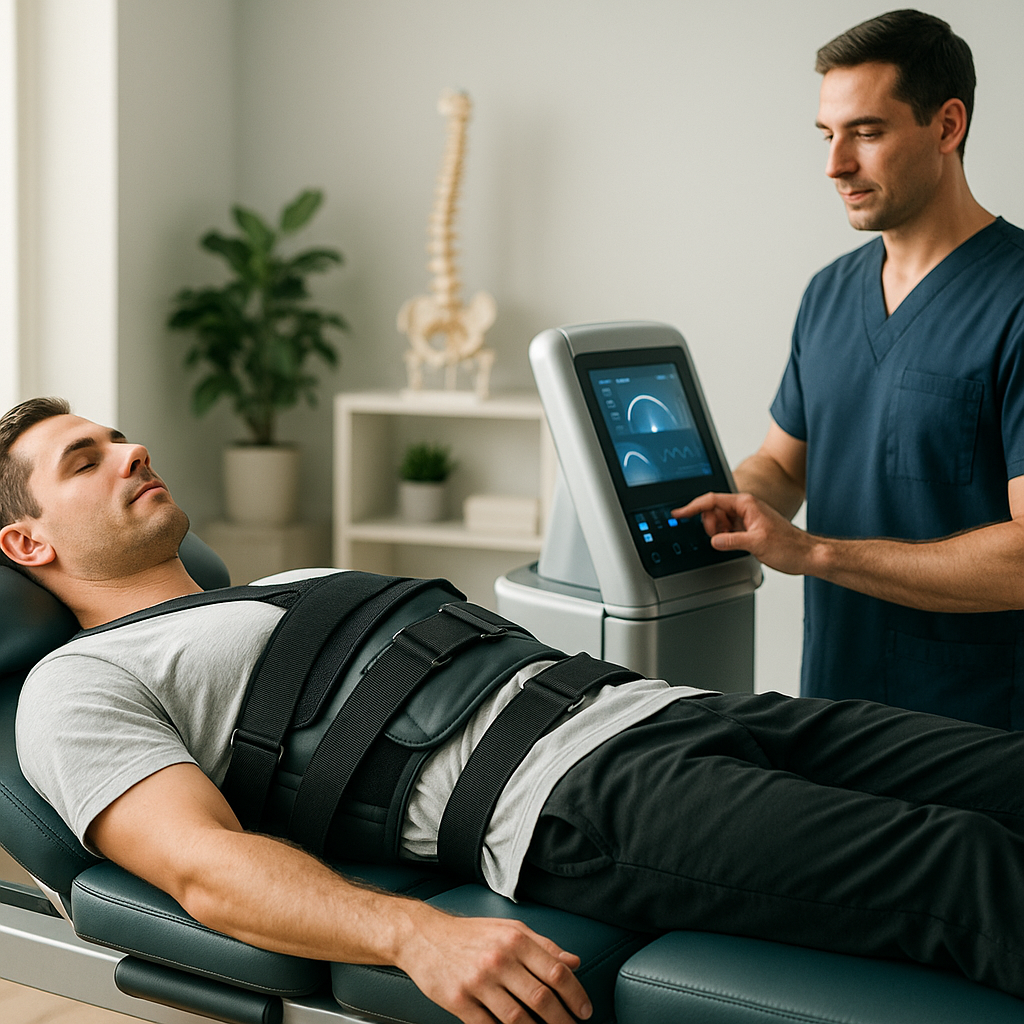
Non-surgical spinal decompression is performed using a specialized non-surgical spinal decompression machine, which is a motorized table or traction device that supports precise, controlled stretching of the spine. During a session, the patient lies on the table while a harness is fitted around their hips. The lower portion of the table then moves, creating a gentle pulling force along the spinal column.
What makes modern spinal decompression machines particularly advanced is their computer-controlled nature. The equipment is programmed to deliver intermittent traction — alternating between periods of distraction and relaxation — which prevents the body’s natural reflexive muscle tightening that can counteract the benefits of traditional traction. This cycle of pull and release is what makes the therapy so effective at facilitating disc rehydration and nerve decompression.
Spinal Decompression vs. Mechanical Traction Therapy
It is important to distinguish between spinal decompression treatment and conventional mechanical traction therapy, as the two are often confused. While both methods involve applying a pulling force to the spine, there are meaningful differences in approach and outcome.
- Mechanical traction therapy applies a constant or static pulling force to the spine, which can sometimes trigger muscle guarding — an involuntary muscle contraction that limits the effectiveness of the treatment.
- Spinal decompression therapy, on the other hand, uses a dynamic, computer-controlled system that cycles through phases of tension and relaxation. This prevents muscle guarding and allows for more targeted and therapeutic disc decompression.
- Spinal decompression machines are designed with sophisticated feedback mechanisms that continuously monitor the body’s resistance and adjust the force accordingly, making it a far more precise and patient-specific treatment.
While mechanical traction therapy still holds value in certain clinical settings, spinal decompression is generally considered the more refined and effective evolution of this approach for treating disc-related conditions.
Conditions Treated With Spinal Decompression
Spinal decompression treatment is used to address a variety of spinal conditions, particularly those involving the intervertebral discs and nerves. Healthcare providers commonly recommend this therapy for patients diagnosed with:
- Herniated or bulging discs — where disc material protrudes beyond its normal boundaries and presses on adjacent nerves
- Degenerative disc disease — a gradual deterioration of the intervertebral discs due to ageing or wear and tear
- Sciatica — pain radiating along the sciatic nerve, often caused by disc compression in the lumbar spine
- Spinal stenosis — a narrowing of the spinal canal that puts pressure on the spinal cord and nerves
- Facet syndrome — pain arising from the small joints at the back of the spine
- Posterior facet syndrome and other chronic lower back or neck pain conditions
It is worth noting that spinal decompression is not suitable for everyone. Patients with osteoporosis, spinal fractures, spinal implants, tumours, or who are pregnant are typically advised to explore alternative treatments. A thorough evaluation by a qualified healthcare professional is always necessary before commencing therapy.
What to Expect During a Spinal Decompression Session
A typical spinal decompression session lasts between 30 and 45 minutes. Most treatment plans involve a series of sessions — commonly ranging from 15 to 30 visits over several weeks — tailored to the patient’s specific condition and response to therapy. Here is a general overview of what a session entails:
- Initial assessment: The clinician evaluates the patient’s medical history, imaging results, and specific symptoms to customise the treatment parameters.
- Positioning: The patient is comfortably positioned on the decompression table, either face-up or face-down depending on the area being treated.
- Harness fitting: A pelvic or cervical harness is secured around the patient to allow for controlled traction.
- Treatment cycle: The machine initiates its programmed cycle of gentle traction and relaxation, with the clinician monitoring patient comfort throughout.
Additional Resources













