
Understanding Nerve Conduction Testing in Chiropractic Care
When patients experience unexplained pain, numbness, tingling, or muscle weakness, identifying the root cause becomes a critical first step toward effective treatment. Nerve conduction testing, commonly referred to as a nerve conduction velocity (NCV) test, is one of the most valuable diagnostic tools available in modern chiropractic care. By measuring how efficiently electrical signals travel through the peripheral nerves, chiropractors and healthcare providers can gain precise insight into nerve function and identify areas of dysfunction that may be contributing to a patient’s symptoms.
This article explores what nerve conduction testing involves, how it is used within a chiropractic setting, what patients can expect during the procedure, and why it plays such an important role in developing a comprehensive and targeted treatment plan.
What Is a Nerve Conduction Study?
A nerve conduction study (NCS) is an electrodiagnostic test that evaluates the speed and strength of electrical signals as they move along a nerve pathway. Nerves communicate by transmitting electrical impulses, and when these impulses slow down or become disrupted — due to injury, compression, inflammation, or degenerative conditions — patients often experience a wide range of neurological symptoms.
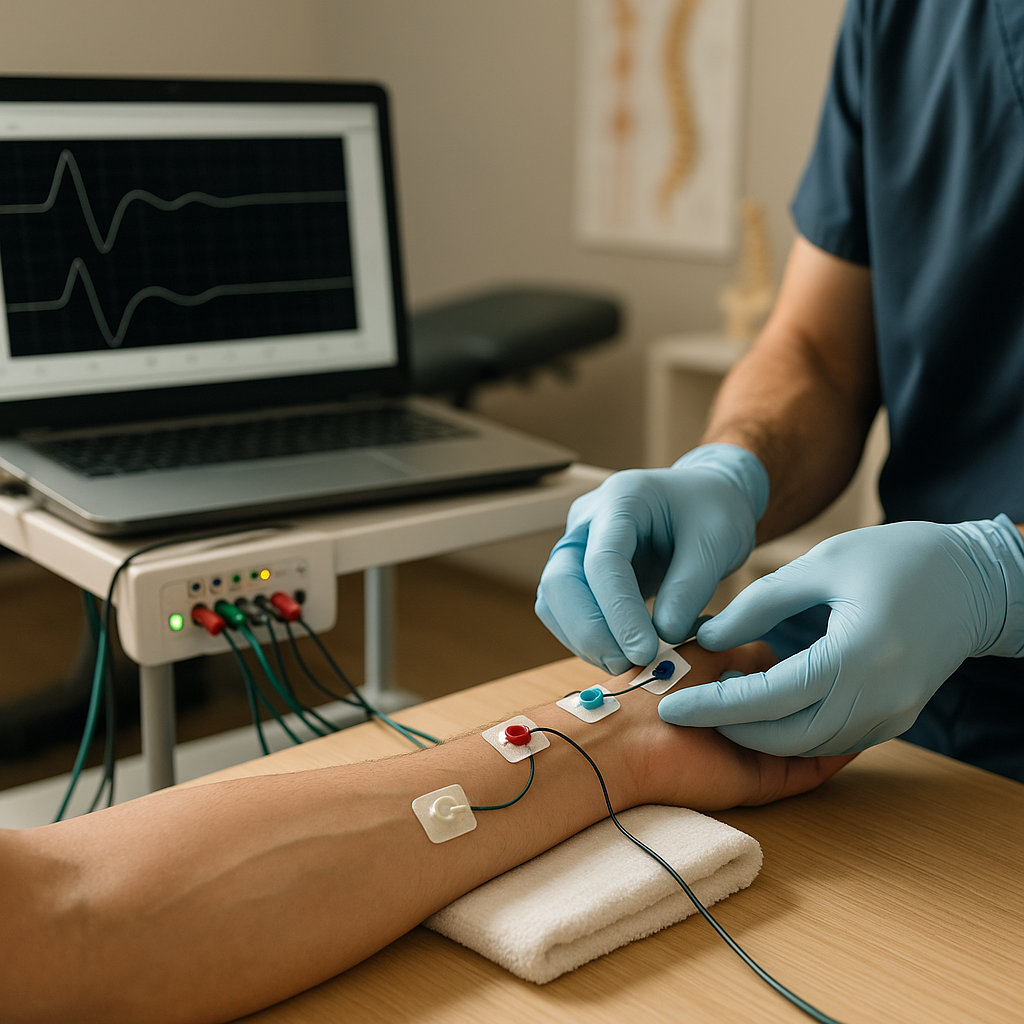
During a nerve conduction study in chiropractic practice, small electrodes are placed on the skin over specific nerves. A mild electrical stimulus is then delivered to one electrode, and the resulting signal is recorded at another location along the same nerve pathway. The time it takes for the signal to travel between these two points — combined with the distance — is used to calculate the nerve conduction velocity.
A reduced conduction velocity or diminished signal amplitude often indicates damage or compression affecting the nerve’s myelin sheath (the protective coating surrounding nerve fibers) or the axon itself. This information is essential for guiding clinical decision-making and refining chiropractic treatment strategies.
How Is Nerve Conduction Testing Used in Chiropractic?
Chiropractic care extends well beyond spinal adjustments. Many chiropractors are trained in electrodiagnostic procedures, including nerve conduction studies, either performing them directly or referring patients to specialists when warranted. In either case, the results of a nerve conduction study chiropractic evaluation can significantly influence the direction of care.
Nerve function testing is particularly useful in chiropractic settings for:
- Diagnosing the cause of radiating pain: Conditions such as sciatica, cervical radiculopathy, or lumbar radiculopathy produce symptoms that travel along specific nerve pathways. NCS testing helps confirm whether nerve compression or irritation is responsible.
- Evaluating peripheral neuropathy: Patients with diabetes, nutritional deficiencies, or autoimmune conditions may develop peripheral neuropathy. Nerve conduction testing can assess the extent and distribution of nerve involvement.
- Detecting carpal tunnel syndrome: One of the most common applications of NCV testing is the evaluation of median nerve function in patients suspected of having carpal tunnel syndrome.
- Assessing post-injury nerve damage: Following trauma, such as a motor vehicle accident or sports injury, nerve conduction studies help determine whether nerve damage has occurred and to what degree.
- Monitoring treatment progress: Repeated NCV testing allows clinicians to objectively track improvements in nerve function over the course of chiropractic treatment.
NCV Test: What Patients Can Expect
Many patients feel apprehensive about nerve conduction testing when they first hear it involves electrical stimulation. However, the procedure is generally well-tolerated and does not carry significant risks or side effects. Understanding what to expect can help patients feel more at ease before their appointment.
Here is a step-by-step overview of what typically occurs during an NCV test at a chiropractor’s office or affiliated diagnostic facility:
- Patient preparation: The clinician will review the patient’s medical history, current symptoms, and any relevant imaging or laboratory results. Patients are usually asked to avoid applying lotions or oils to the skin on the day of the test, as these can interfere with electrode placement.
- Electrode placement: Small surface electrodes are attached to the skin at specific anatomical locations corresponding to the nerves being evaluated. The placement is precise and based on established neurological landmarks.
- Electrical stimulation: A controlled, mild electrical pulse is delivered through one electrode. Most patients describe the sensation as a brief, sharp tingling or a mild muscle twitch. The intensity is carefully adjusted to remain within a comfortable range.
- Signal recording: The electrical response is captured by the recording electrode and displayed on a monitor. Key measurements include latency (the time delay before the signal arrives), amplitude (the strength of the signal), and conduction velocity (the speed of transmission).
- Review and interpretation: The results are compared against established normative values for age, height, and gender. Abnormal findings are documented and incorporated into the overall clinical assessment.
The entire procedure typically takes between 30 and 60 minutes, depending on the number of nerves being evaluated. Patients can resume normal daily activities immediately afterward.
Nerve Conduction Studies vs. Electromyography (EMG)
Nerve conduction studies are frequently performed alongside electromyography (EMG), and the two tests are often discussed together in the context of electrodiagnostic chiropractic evaluation. While they are complementary, they measure different aspects of neuromuscular function.
An NCS measures the electrical activity along the nerve itself — specifically, how quickly and effectively a nerve conducts impulses. An EMG, on the other hand, involves the insertion of a fine needle electrode into a muscle to assess its electrical activity at rest and during contraction. EMG testing provides information about the health of the muscle and the motor nerve fibers supplying it.














